

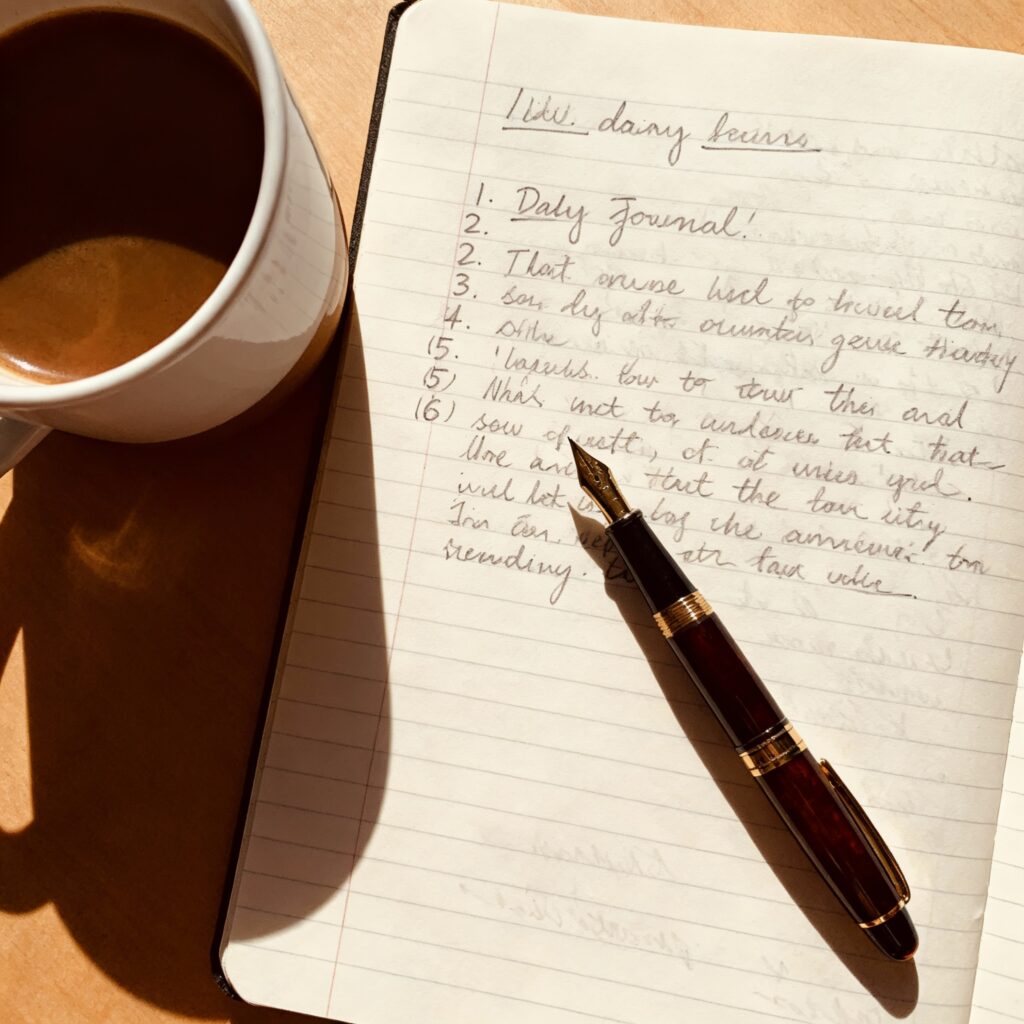
Paper does something digital tools cannot: it creates a direct line between hand and brain. In our hyper-connected digital world, where screens dominate work and life, putting pen to paper offers a refreshing cognitive reset. Research shows that handwriting engages more areas of the brain than typing, activating regions tied to memory, creativity, and critical thinking. This enhanced brain connectivity makes analog methods an underutilized secret weapon for product leaders and busy professionals seeking clarity in complex environments.
Morning Big Rocks
The day starts with a single sheet of paper. Writing down the “big rock” tasks for the day grounds my intentions before the digital chaos begins. This analog ritual forces prioritization in a way no app can match. When space is limited to physical dimensions, decisions become clearer. There is no infinite scroll, no ability to defer indefinitely. Three to five big rocks fit on paper. The act of handwriting these tasks creates a deeper commitment than typing them into a project management tool. The brain processes information differently when forming letters manually, establishing stronger neural pathways for retention and follow-through.
Evening Mind Release
At the end of the day, the notebook reopens for freeform journaling. This practice releases mental tension built up from meetings, decisions, and context-switching. The structure is simple: one moment of gratitude, one thing that went well, and something that did not. This framework provides just enough guidance without becoming prescriptive. Studies on expressive writing show that journaling about experiences improves emotional regulation and cognitive processing. Writing by hand slows thinking enough to allow deeper reflection, moving beyond surface-level reactions to more meaningful insights. The physical act of writing provides a natural closure to the workday, signaling to the brain that processing is complete.
Brainstorming Kickstart
Paper brainstorming serves as a cognitive catalyst before transitioning to digital tools. Sketching ideas, mapping concepts, or listing features on paper activates creative thinking without the constraints of software interfaces. The brain engages differently when no templates, menus, or formatting options interrupt the flow. This analog phase generates raw material that gets refined in digital tools later. Notion, Figma, or Jira become execution environments, not ideation spaces. The hybrid approach blends the cognitive benefits of handwriting with the collaboration and scalability of digital platforms. Starting analog removes friction from the creative process while preserving the practical advantages of modern productivity software.
Pre-Presentation Memory Aid
Writing main concepts by hand before presenting creates mental anchors. This technique leverages the encoding effect, where the physical effort of forming letters strengthens memory retention and recall. Typing slides does not engage the brain’s memory systems as deeply, leading to verbatim transcription rather than conceptual understanding. Handwritten notes transform into mental references during presentations, reducing dependence on slides or speaker notes. The multisensory experience of writing connects visual, motor, and cognitive processes in ways that support real-time retrieval under pressure. For high-stakes presentations where authenticity matters, this preparation method builds confidence through genuine comprehension rather than rote memorization.
The Hybrid Approach
Digital tools dominate productivity workflows for good reason: searchability, collaboration, and automation. The goal is not to abandon these capabilities. Paper complements digital systems by addressing their cognitive limitations. Handwriting engages the brain differently, creating stronger memory encoding and deeper processing. Analog methods reduce digital distraction, simplify decision-making through physical constraints, and provide a tactile connection to work. Product leaders juggling strategy, stakeholder management, and execution need tools that support both rapid iteration and deep thinking. Paper handles the latter. Asana, Slack, and Google Docs handle the former.
Resources
- https://pmc.ncbi.nlm.nih.gov/articles/PMC11943480/
- https://www.npr.org/sections/health-shots/2024/05/11/1250529661/handwriting-cursive-typing-schools-learning-brain
- https://www.psychologytoday.com/ca/blog/positively-media/202403/writing-by-hand-can-boost-brain-connectivity
- https://www.frontiersin.org/news/2024/01/26/writing-by-hand-increase-brain-connectivity-typing
- https://lrara.com/en-ca/blogs/your-journal-journey/the-power-of-handwritten-journaling-benefits-and-reasons-to-keep-a-personal-diary
- https://collegeinfogeek.com/analog-productivity/
- https://epica.com/blogs/articles-by-epica/benefits-handwriting-10-amazing-truths
- https://fortelabs.com/blog/the-analog-productivity-system-journaling-for-every-season-of-life/
- https://www.scientificamerican.com/article/why-writing-by-hand-is-better-for-memory-and-learning/
- https://www.pockitudes.com/blog/the-healing-power-of-handwriting-how-putting-pen-to-paper-transforms-your-mental-wellness
- https://www.psohub.com/blog/digital-and-analog-tools-for-productivity
- https://oxfordlearning.com/how-writing-by-hand-boosts-memory-and-learning/
- https://pmc.ncbi.nlm.nih.gov/articles/PMC4274624/
- https://www.uhhospitals.org/blog/articles/2018/05/what-your-handwriting-may-say-about-your-health
- https://www.news-medical.net/news/20241209/Writing-by-hand-enhances-brain-function-critical-for-learning.aspx
- https://thesweetsetup.com/chloes-digital-analog-setup/
- https://www.frontiersin.org/journals/psychology/articles/10.3389/fpsyg.2023.1219945/full
- https://wires.onlinelibrary.wiley.com/doi/10.1002/wfs2.1536
- https://www.people-onthego.com/blog/in-this-age-of-digital-distraction-i-use-a-notebook-and-timer-for-increased-productivity
- https://canadianworkplacesolutions.ca/articles/f/why-handwriting-is-good-for-your-brain