

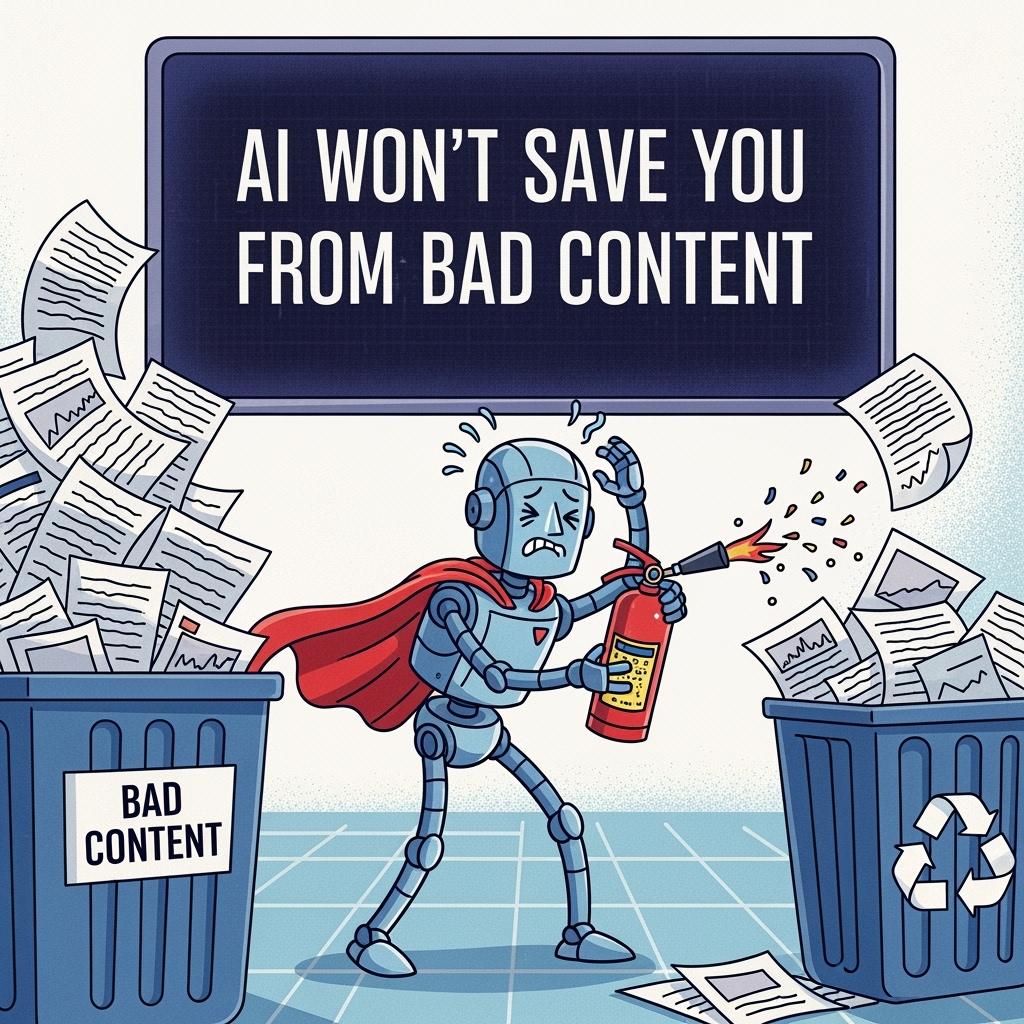
(But It Might Help You Make Better Content)
Remember when spell check came out and everyone thought it would end typos forever? Yeah, about that.
AI content tools have arrived with similar promises. “Generate perfect content in seconds!” they cry. “Never struggle with writer’s block again!” they proclaim. And technically, they’re right. You can generate content in seconds. Whether anyone should read it is another question entirely.
The Uncomfortable Truth About AI Content
Here’s what nobody wants to admit: AI makes it easier to produce mediocre content at scale. Congratulations, you can now flood the internet with perfectly grammatical nonsense faster than ever before.
The real tragedy? Most people use AI like a microwave dinner. Push button, receive content, serve lukewarm to unsuspecting readers. No seasoning. No quality control. No soul.
You Are Not a Content Factory Manager
Using AI for content creation doesn’t make you a supervisor watching machines work. You’re not sitting back while robots do your job. You’re supposed to be directing, shaping, and perfecting.
Think of AI as your overeager intern. Smart? Yes. Helpful? Absolutely. Ready to run your entire operation unsupervised? Not unless you enjoy explaining to your boss why your latest report claims Shakespeare invented the telephone.
The Hallucination Problem Nobody Talks About
AI hallucinations aren’t cute quirks. They’re reputation destroyers waiting to happen. That confident-sounding “fact” your AI just generated? It might be complete fiction. The statistics it quoted? Could be from an alternate universe where math works differently.
Every piece of AI-generated content you publish has your name on it. When your AI assistant decides to invent a new law of physics or misquote a CEO, guess who gets the angry emails? Hint: not the AI.
Raise Your Standards, Not Your Output Volume
AI should free you to do better work, not more work. Those hours you save on first drafts? Invest them in:
- Research that actually matters
- Fact-checking every single claim
- Adding insights only humans can provide
- Crafting arguments that hold water
- Making your content genuinely useful
The goal isn’t to work less. The goal is to work better.
The Framework for AI Content That Doesn’t Suck
Before you prompt:
- Know exactly what you want to say
- Understand your audience’s actual problems
- Have your facts ready to verify
During creation:
- Guide the AI with specific, detailed prompts
- Iterate multiple times
- Challenge every assumption
After generation:
- Read every word critically
- Verify every fact independently
- Rewrite anything that sounds generic
- Add your unique perspective
- Test your arguments for logic holes
Own Your Work or Don’t Publish It
Publishing AI-generated content without thorough review is like signing a contract without reading it. Sure, it might work out fine. Or you might accidentally agree to name your firstborn after a cryptocurrency.
Your reputation takes years to build and seconds to destroy. One unchecked hallucination, one obviously AI-generated paragraph that says nothing in 200 words, one piece of advice that’s dangerously wrong, and your credibility evaporates.
The Bottom Line
AI is a tool, not a replacement for thinking. Use it to amplify your expertise, not to fake expertise you don’t have. Use it to work smarter on the right things, not to work less on everything.
Every piece of content you create is a reflection of your standards. AI can help you meet those standards more efficiently. It cannot set them for you.
Take ownership. Do the work. Make something worth reading.
Because if you’re not willing to carefully read your own content, why should anyone else?